Rediscovering evil
Remembering we are engaged in spiritual warfare might just help us navigate contemporary concerns around AI and more

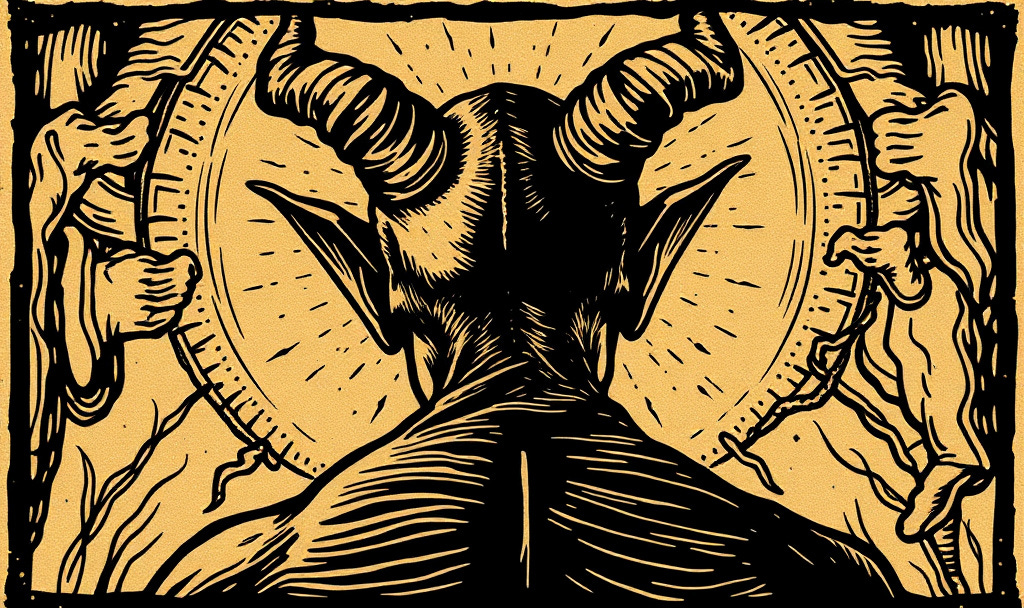
Both the Old and New Testaments are quite clear that bad things are not simply the result of bad choices by free human beings. There are also personal, malevolent, demonic forces at work, and our lives as followers of Jesus are caught up in cosmic spiritual battles. And yet while we may pay lip service to this, many Christians live as functional materialists, finding talk of Satan and spiritual warfare all a bit confusing and distasteful. In this episode we explore why it is some streams of Christianity have lost sight of the reality of spiritual evil, and how recovering this theology might help us better live faithfully and wisely in our present age.
Listen to the podcast directly below, or click here to find it on your podcast app of choice and subscribe to get new episodes every Wednesday sent straight to your device.
Transcript
[Transcribed with AI, there may be some very minor inaccuracies]
Tim Wyatt: Well, hello and welcome to another episode of Matters of Life and Death. As always, I’m Tim Wyatt, and I’m joined today, as ever, by my dad, John Wyatt. Hi Dad.
John Wyatt: Hi Tim.
Tim Wyatt: Today we’re going to be doing one of our occasional episodes where we take a step back from the tumult of breaking news and scientific developments and crushing ethical dilemmas, and think about some of the big-picture theology, Christian thinking, and traditions that lie behind what we are reflecting on and discussing.
You would have heard we redid over the Christmas and New Year’s break our big-picture story, looking through the four beats of the salvation story: creation, fall, redemption, new creation. And today, we want to take a little look at the question of evil, which I guess I grew up with as one of those classic problems, almost purely in the realm of apologetics: how do we reconcile the problem of evil? It’s a question really about evangelism and apologetics. But you think that might be a little misguided. Why don’t you take us away with what your thought is?
John Wyatt: I’ve been reading and researching this topic of a biblical understanding of evil for some time. The reason I got into it was because, as you know, I’ve been interested in AI, and one of the novels that I read very early on was a novel by C. S. Lewis called That Hideous Strength. It’s one of his science fiction trilogy.
If listeners have never read that novel, I recommend it. It’s quite a weird novel. A modern description might be something like “magic realism,” because it’s a strange book, but it has a powerful message. The powerful message is that it tells the story of a cutting-edge science organization, government-funded, called NICE. He’s writing at the end of the Second World War, and it stands for the National Institute for Co-ordinated Experiments.
Basically, they’re doing strange experiments. These are cutting-edge scientists, all very hush-hush. It turns out what they’re actually trying to do is keep alive a decapitated human head, the head of a master criminal. They’re using physiological techniques, tubes and so on, and Lewis gives this weird description of all this science keeping this isolated head going. The theory is that they’re trying to make it super-intelligent. They’re giving it various chemicals, because it was already a master criminal, and their idea is that if they can give chemicals to make this thing increasingly powerful, then...
Speaker unknown: No spoilers.
John Wyatt: I won’t give away the plot. But part of the brilliance of Lewis’s idea is that he makes the point that the very materialism of the scientists—because they are simply doing physics and physiology, and have no category for evil, no category for the demonic—makes them open to these demonic forces.
That novel has haunted my imagination for many years, ever since I read it as a young man. This idea that materialistic scientists do not have a category for evil, I think, is a very interesting and important point. And I think it’s relevant to AI today, because the technicians, engineers, and scientists working in Silicon Valley, by and large—and it’s a generalization, but by and large—it seems they don’t have a category for evil either.
If you live in a world of ones and zeros, then evil doesn’t compute. You can understand programming error, you can understand bugs, you can understand some kind of freak mishap, but the idea of personal malevolence, in particular a kind of spiritual malevolence, simply doesn’t make any sense in a materialistic cosmos.
Tim Wyatt: But everyone, even ultra-materialists, recognizes that people do bad things: hurt and kill each other and steal and lie. Even if you don’t have any kind of animating moral explanations about why that happens, it’s not really possible to live in this world and believe that, fundamentally, these are all just amoral natural processes.
Everyone lives in a world where there is crime and sadness and death and suffering.
John Wyatt: Yes, but if you’re a consistent materialist, you have to say the idea of good and evil—these are human fictions which we’ve invented. We’ve invented the idea that if you’re nice to people, this is “good,” and if you kill and torture people and cause great suffering, this is “bad.” But actually, these are merely human games we’re playing.
Take the most terrible evil—often the Holocaust and Hitler are taken as examples of terrible evil. What was going on? Simply mechanisms in Hitler’s brain were firing off. Random mechanisms were just going on in their brains, and it was just physics working its way out. We think, “Oh, that’s terrible.” But at the level of physics and science, this has no meaning. These are just games we play.
And of course, ultimately, that’s nihilism—moral nihilism—and it’s deeply, deeply destructive.
Tim Wyatt: Does anyone actually live like that? I mean, I agree that is the logical conclusion if you are a materialist. But even Richard Dawkins is on the record as saying he still finds it distasteful when people hurt other human beings. Even if you can’t necessarily give a kind of evolutionary explanation for why that should be, he still thinks you shouldn’t go around exploiting people and manipulating and lying and cheating and hurting.
And I think that is true even of the most amoral tech billionaire. If I went and stole from his grandma, he would say that was bad, that was a wrong thing to do—even if he doesn’t really believe in the categories of wrong or right in theory.
John Wyatt: Another very good example is cheating on your spouse or lifelong partner. They would all agree that is bad, but when you push them—”Okay, so what is ‘bad’? What does it mean to be bad?”—they basically say, “Well, it makes me feel bad.”
Tim Wyatt: It’s about preferences, isn’t it? “It’s not my preference that that happened.”
John Wyatt: Yes, it’s sometimes called emotivism. It’s the idea that it’s all about the emotion: “I don’t like that, it makes me feel bad.” And of course, that’s part of the whole moral confusion of the world we live in.
I think it’s particularly important when you’re dealing with technology, because if you have this idea that, fundamentally, there is no such thing as evil at an objective level, there’s simply physics, you can see how easy it is for people starting off with good intentions and ending up doing terrible things—which is, I’m afraid, what we’re seeing so often with the tech giants.
So I believe that Christians, in theory, have a very different story to tell, because at least in theory, Christians do take evil very seriously. It’s something we anticipate. We know that human beings are fallen. We know that they’re going to do bad things, even good people. We know that evil can be very deceptive, that it can be subtle. And ultimately, we have this teaching that there is an Enemy with a capital E: there is a spiritual force of evil in the world who is our enemy and who is dedicated to attacking humanity.
Tim Wyatt: I think it would be fair to say that a lot of contemporary Christianity, particularly the evangelicalism that we are both swimming in, sometimes shies away from the personal nature of evil—the demonic. We talk a lot about human sin coming from human hearts, and that the fundamental thing that Jesus came to solve was the brokenness that flows from within, and to forgive and redeem that.
The serpent element of the narrative is airbrushed out slightly, and we mostly think about Adam and Eve and what they did wrong in the garden, and we don’t spend that much time dwelling on what it meant that there was another created being, not in the image of God, who was purely and utterly malevolent and deceitful.
John Wyatt: I think that’s absolutely right. And it’s interesting to try and unpick why this has happened. I’m pretty sure that if a Christian from a century or two ago came and looked at us—certainly from the sort of Puritan era—they would notice how rarely our modern Christianity refers to evil, except in this kind of therapeutic register.
So, for instance, people say the reason people do bad things must be abuse, trauma, psychological mechanisms. Therefore, as Christians, we want to understand those psychological mechanisms. We want to take account of them. We want to bring the healing of Christ to those mechanisms. But we’ve placed “the evil within” in psychological, therapeutic terms.
Tim Wyatt: And something similar happened, didn’t it, in wider culture in the 20th century, where there was a kind of Freudian turn. For a relatively brief period, there was this sense that actually criminal justice systems exist not to punish or deter or protect; they’re there really to treat.
All acts that a society deems to be bad are actually the result of, as you say, childhood trauma and mental ill health and other forms of brokenness. We should be effectively closing prisons and putting people in asylums and institutions instead. That, I think, was compelling for a while, but then there was a very strong turn away from that after a few decades.
And I think the last 50 years has really been a story, certainly in the West anyway, of people rediscovering the punitive aspect of criminal justice and the sense that some people are just bad people who need to be punished and locked up.
John Wyatt: I’m not convinced you’re entirely right. At a popular level, at what you might call the “hanging and flogging” fraternity, yes, there’s exactly that attitude. But I think at the elite level—in the academy, in the medical profession, among opinion-formers—actually that therapeutic model is still there.
Because evil doesn’t exist, there’s no such thing as evil people. There are people who’ve got bad programming, and our job is to get the good programming. And maybe prison isn’t very good at that, so let’s find a better way of reprogramming offenders.
Speaker unknown: So I think it’s still there.
Tim Wyatt: Going back to the church, it seems quite clear to me that part of the reason why certainly the evangelical church in the last few hundred years has drifted away from talking about demons and evil and personal spiritual evil is part of that general post-Enlightenment disenchantment that all of Western culture has undergone.
We’ve all taken a materialist turn. Obviously Christianity has held on to the fundamental spirituality—there is a transcendent, immaterial God—but the rest of the panoply that you see in Scripture, things like angels as well as demons, the person of Satan, has often, I think, been relegated and downplayed.
We don’t want to be like those “superstitious medieval folk” who, every time they tripped over in a puddle, thought that was a demon. Everything was incredibly spiritualized, “enchanted” in the jargon of sociologists. We’ve been disenchanted, and now we don’t really believe in that. We’re big enough to believe it’s just about us, this real material world, and then there’s a God up there as well.
John Wyatt: Yes, there’s a lot in that. It’s worth pointing out that’s not universal in all Christianity, is it?
Tim Wyatt: The Pentecostal denominations, quite the opposite, have—
John Wyatt: —have retained very strongly the concept of demonic evil and so on.
Tim Wyatt: And in something like Catholicism, with its ideas around saints, angels, Mary, there’s a very thick sense that this world is more than just what we can see, and there are miracles and supernatural events, and it’s porous, and everything is stranger than you imagine.
I think it’s largely a Protestant, Reformed tendency to try and strip away some of that stuff.
John Wyatt: Yes, it is, and I think it’s recent—a post-Enlightenment phenomenon. People like Charles Taylor, the philosopher, and others have made the distinction between what they call the medieval universe and the modern one.
In the medieval universe, it was a porous universe: there was a constant interchange between hidden spiritual forces, both good and evil, and the material forces. They argue that that was the universe which goes all the way back to biblical times—that the biblical writers inhabited a porous universe, a porous cosmos, where spiritual forces and human forces, and also natural forces, all interacted.
In the biblical worldview there are three forces: there are human forces; there are natural forces, like the seas and the winds and the foundations of the earth and the chaos which is always threatening to invade; and there are spiritual forces. All three are engaging with one another.
Something happens with the rise of the scientific age and then the Enlightenment: basically the universe becomes closed.
Speaker unknown: Now it is simply cause and effect.
John Wyatt: This concept of a porous universe is lost. I think we’ve been much more influenced by that, as modern Christians, by that kind of closed-universe thinking. One of the questions is, how seriously do we take the biblical worldview?
Are we going to say, “Well, of course they thought in those terms, but we are now educated, post-Enlightenment Christians; we know better”? Or are we going to say, “We take biblical authority seriously,” in which case we really have to try and rethink ourselves back into that porous cosmos?
Tim Wyatt: And I think that’s a very astute question towards evangelicals like us, who are, in theory, biblicist people, who are supposed to have the Scriptures as their final authority.
The challenge is not so much—there would be some Christians, some evangelicals, who would entirely deny the existence of demonic forces. I think it’s rare, for the reason you say, that this is quite self-evident in Scripture.
I think the bigger challenge is evangelicals who would, with their lips, say, “Well, of course we believe in angels and demons and the devil and spiritual evil,” but with their lives and in their sermons and their prayers, they act as though they don’t. They’re functional materialists, even if in theory, according to their doctrines written down, they do pay lip service to the idea.
And I guess the challenge would be: how do we live as Christians in this reality, so that this spiritual reality that is very clear in Scripture actually bleeds over into how we act and think and pray and speak and worship, not just what we claim we believe in our heads?
John Wyatt: Absolutely, I think that’s absolutely right. You’ve nailed it. Although we pay lip service to this concept of the porous universe and of the powers, principalities and powers, we are functional materialists.
Another way of putting that is I was trying to think of an imagery. Many of us think in our heads as though we were living in the American Old West, in the frontier town, where basically there is just empty space around us and we’re free.
Tim Wyatt: So they thought.
John Wyatt: So they thought. Yes, of course, actually it was inhabited by an ancient civilization who they were exterminating, as well as megafauna and all that. But if you put yourself into that mindset: “There is empty space. We can invent whatever we like. We can put a town here, we can do this, we can do that, because basically it’s empty.”
Whereas if you were to take the biblical New Testament imagery seriously, it’s much more like: this is 1944 and we’re living in continental Europe, somewhere like Holland. There is a titanic battle going on around us. Yes, in our little village, we don’t see much of that most of the time. We’re able to live our lives. But the reality is, the Normandy beaches are happening over there, and there is Hitler in Berlin, and the Luftwaffe are going out, and there is this titanic battle.
Of course, the whole of your everyday life would be dominated by that realization. You could never forget that you’re in the middle of World War Two.
Tim Wyatt: Just because a soldier didn’t barge into your house that day, people were under no illusions that, as you say, they were caught up in the midst of a war.
John Wyatt: And I don’t think that’s an overstatement of what the biblical worldview is. If you just think about the entire story from Genesis to Revelation—and we have talked about this before—but if you look from this perspective: one of the characteristics of what it means to be human, which we don’t often think about, is that humans are contested, under attack.
That’s true about humans from Genesis 3, from the Garden of Eden: they are under attack all the way through to the end of Revelation, when finally and ultimately evil, the dragon and the serpent, is consigned into the fiery pit. So humanity is to be under attack, and we’re under attack by a very sophisticated enemy.
You get that, don’t you, in the serpent in Genesis 3: an extremely sophisticated, intelligent, knowing, manipulative, deceptive being, utterly dedicated to the destruction of God’s plans and to the corruption of human beings.
We’re never once told, “Where does that voice come from?” Why would God create a serpent? Why is there a serpent in the garden? And yet there is. The hints you get throughout Scripture are that there is warfare in the heavenly places which precedes the creation of human beings—a kind of primordial rebellion and conflict.
I’ve gone back and looked at the various Scriptures which hint at it, and having reread them, I’m quite persuaded by the historic interpretation.
Tim Wyatt: This is that there were angels, and then some of them rebelled against God and decided to disobey him, and there was some kind of clash, and Satan was then cast out of heaven as the chief of the disobedient angels—that kind of tradition?
John Wyatt: Correct. And also that Satan—again, this is largely tradition, but there are hints—was the most beautiful of the created angelic beings.
Tim Wyatt: So Lucifer means something like “bringer of light” or something like that.
John Wyatt: Exactly. And so there is a terrible evil beauty about these forces: they have intelligence, sophistication, they’re cunning.
The very image of the serpent is a striking image. Somebody said this to me before, and it really struck me. When you go to London Zoo, you don’t need to say, “How are we going to find the elephants? Do you think we can spot the giraffe?” It’s not difficult to spot those animals.
But when you go into the reptile house, you say, “Where are the snakes?” They are brilliantly camouflaged, motionless and watching. That whole image of the serpent is very striking, isn’t it?
Tim Wyatt: I guess this leads to one of the critiques or pushbacks from the tradition that I grew up in, which was kind of: “We’re not told details about spiritual evil, and that’s for good reason. God doesn’t want us to get lost in these rabbit warrens, spiralling out of control, because humans get obsessed with this. They start to see Satan everywhere and load onto this very scant information in Scripture stuff that’s not warranted. Better just to focus on your own thing, focus on what you can change, and let God worry about some kind of putative spiritual battle.
What’s your response to that idea that this is kept obscure from us for a reason, and we’re not supposed to go poking around—that this is dangerous?”
John Wyatt: I think it’s a half-truth, what you’ve just said. There is a truth to it, because it is striking in Scripture how we are never told details about, to use a philosophical term, the ontology of evil—what is its ultimate being, its philosophical nature, where it comes from. We’re not given a systematic theology.
It’s partly because this is darkness as opposed to light. We are given the light of the gospel; we’re given the light of revelation. But there is a prince of darkness, and the darkness hides itself. The darkness is obscure.
You’re right that there is—and this comes to the famous C. S. Lewis quote—two equal and opposite errors that people fall into. They either dismiss evil out of hand as being medieval, or they develop an unhealthy fascination with evil and become utterly absorbed and obsessed with it. Both are wrong.
If I was to say, “Which of those two errors do you think modern contemporary evangelicalism is at risk of?”—it’s pretty obvious. We’re not obsessed by the origins of evil. We don’t spend our time wondering about what demonic influence is up to. I think we’ve airbrushed it out.
Just to go back to the biblical story: in the Old Testament there are often, at a more allusive level, hints about spiritual warfare. It’s not really until you get to the New Testament that this spiritual battle theme becomes very strong.
It is particularly striking, as I’ve been studying this, how this explains why the exorcism narratives in the Bible have such a key place. I think this has often been something that has rather embarrassed modern-day evangelicals. “Let’s read the gospel together. What’s all this about Jesus casting out spirits? What is all this about?”
Tim Wyatt: It’s a very prominent theme in all of the Gospels: Jesus is not just doing battle against sickness and death, which he is—he’s healing people left, right, and centre, he’s raising the dead—but he’s also doing battle against a more personal and immaterial evil, demons, primarily, who have occupied and taken over other human beings.
It’s not one or two; as the narrative has it, he is constantly stumbling across people who are demonically possessed, and he is casting them out. When he sends out the seventy-two, what do they come back and say? “Demons fled before us.” So this was not just something that he was doing. This was a significant central part of that ministry, which I think we as 21st-century moderns find troubling.
John Wyatt: I think that’s right. Not only that, but there’s something very obvious about the exorcism narratives: whereas the rabbis and the Pharisees didn’t have a clue who this wandering preacher was, the demons knew perfectly well.
“What have you to do with us? We know who you are, Son of the Most High.” It’s this idea that it’s more than just a psychiatric illness.
Incidentally, that’s quite an important differential diagnosis. I’ve heard it said by people who might have more expertise than I do that whereas with most mental illness there is a generalized disorder of thinking—which often includes religious themes (people often think they’re God, or they think Satan is talking to them)—the characteristic of New Testament demonic possession was a specific resistance to Jesus.
It was only when Jesus was passing by that they became really agitated. There is a very specific resistance to Jesus, but also some kind of spiritual insight about spiritual forces. That does seem to be a theme.
One of the important things that Jesus says—when they accuse him of being the prince of demons, “By Beelzebul you are casting out demons”—he uses this very significant phrase, which has passed into spiritual history, called “binding the strong man”:
“Unless a strong man is bound, you will never be able to take his property. But if you bind the strong man first, then you will be able to plunder his house.”
That’s an important metaphor, because basically what Jesus is claiming is that in his own person, he has bound the strong man of evil, of evil possession, and therefore he is able to exercise authority over them.
Tim Wyatt: I think when I’ve heard that passage preached, it’s often done in a way that points to, “This is all about Jesus establishing his power and his identity,” and it’s very theological. But you don’t often hear people suggesting that the strong man is still at play today, and we too, as followers of Jesus, need to be at work in using Christ’s power to bind him.
It’s often cast as, “This was what Jesus was doing to inaugurate his messianic ministry and establish his messianic identity.” It’s rarely applied to Christians today.
John Wyatt: I think you’re absolutely right. Related to that is the way the cross is presented by the New Testament writers, which is often in terms of the victory over evil and victory over evil forces.
Of course, the cross is also presented as Christ as the Passover Lamb who dies in our place and whose blood has a substitutionary role. But this concept of Christ triumphing over evil forces in the cross—that the cross was the way in which ultimately evil was defeated—once you go looking for it, it’s absolutely there.
I understand church historians say that this was a dominant way in which the early church used to celebrate the cross. It was not just an individualistic thing of “Christ dying for my sins.” It was a cosmic thing: Christ on the cross overcame evil and vanquished the powers.
But we are still in an era of conflict. That final, ultimate overthrow of evil has not yet happened, and we’re still in the middle of World War Two.
Tim Wyatt: It certainly chimes with me. We’ve talked on the podcast as well about how truly crucicentric theology recognizes that there’s lots going on in the cross. It’s the hinge point of salvation history, and there are lots of different lenses through which you can see it.
Obviously the substitutionary atonement narrative is deeply true and wonderful and core to the gospel. But I don’t think you hear as much, certainly within the evangelical circles I grew up in, about that idea of it being about Christus Victor, as it’s sometimes known in Latin: this theology that, as you say, what Jesus did at the cross was not just about taking away our sins and bearing them on himself and doing that kind of transactional exchange—though it was that—but it was also about defeating other spiritual evil forces, triumphing over them, “scorning their shame,” as it says in Hebrews, to then sit down at the right hand of the Father as the victorious slain-but-then-risen, glorious King.
That theological tradition seems to be—again, no one would deny it—but it’s very much secondary and downplayed, maybe because we are uncomfortable with the spiritual warfare narrative in general.
John Wyatt: Yes, and I think it’s there throughout the New Testament. It’s there in the Gospels, it’s there in the Pauline writings—Paul makes it a central part of his theology. It’s there, as you say, in Hebrews, it’s in Peter, and it’s very definitely there in Revelation, where the Lamb that was slain is now the victor, and every knee will bow.
Tim Wyatt: And there’s a beast to be fought. There’s a beast out of the sea with all these heads and terrifying imagery that has to then be bound and defeated.
John Wyatt: And is ultimately defeated. The beast is motivated by the dragon, which is the serpent. The dragon-serpent is the evil one; the beast is our human empire.
The martyrs witness to Christ through the slain blood of the Lamb. Their own blood—they sacrifice their lives—bears witness to the Lamb who was slain.
So I think it is a very powerful theme. Along with that goes the idea: how do we combat, how do we engage in this spiritual battle? Paul says it’s not by earthly weapons, flesh and blood, but by engaging with spiritual weapons, particularly in prayer.
Tim Wyatt: That passage is utterly explicit, isn’t it? The famous passage in Ephesians 6 about the armour of God:
“Put on the full armour of God so that you can take your stand against the devil’s schemes. For our struggle is not against flesh and blood but against the rulers, against the authorities, against the powers of this dark world and the spiritual forces of evil in the heavenly realms. Therefore put on the full armour of God...”
Paul couldn’t be clearer that the battle we’re engaged in is not just about—though it obviously includes—crucifying, mortifying the sin in our flesh. That’s another significant theme in Paul’s epistles. But there are also, outside of us, beyond our own sinfulness, powers of this dark world and spiritual forces of evil in the heavenly realms.
Both elements are there, as you said: the forces of evil in creation and the forces of evil in a spiritual sense. And we are called to battle against them, not by our own strength, not with our own weapons, but with the armour of God.
John Wyatt: Absolutely. Also, in other Scriptures, you see the deceptive nature of evil. Sometimes evil is very obvious, as it is where we see horrific, terrible things happening across the world, and you say, “Is it just that someone like Putin is a very bad person, or could it be that evil principalities and powers are exacerbating human brokenness? Could it be that there’s a spiritual element in the conflict that is driving Putin on to send Russian soldiers to their deaths—thousands and thousands—in a totally irrational way? Is it possible that there are spiritual forces involved here we can recognize, as well as the human level?”
Tim Wyatt: I guess the other objection a lot of people will have to this kind of narrative is: is it not awfully convenient to be able to displace personal responsibility for bad choices and evil and sin onto these amorphous, vicious, hard-to-pin-down, poorly understood and explained demonic forces?
Is that not just an easy way for us to junk taking responsibility for ourselves? Putin will stand accountable to God for starting the war in Ukraine and all the other evil things he’s done. He’s not going to say, “Oh, it wasn’t me, it was the demons that did it.”
John Wyatt: Absolutely right, and the Bible never does that. Never do the Scriptures say that because evil forces were involved, human accountability is of no significance. It’s always both-and.
Yes, we are always held to account for our actions. But with spiritual eyes, we can see that it’s possible for human beings to become an unwitting tool for evil forces—to become a conduit, to become someone who is being used.
I’ve heard the term “useful idiot”: the idea that some master malevolent planner is taking a useful idiot and using them for their own purposes. And yes, the useful idiot is still accountable for their actions, but that doesn’t mean to say there isn’t a deeper force.
We can see that across the world, that so often evil seems utterly irrational, utterly self-destructive—not only at a cosmic level or national level, but in individual lives. We can think of individuals who commit enormously self-destructive acts and cause damage to other people.
Our natural therapeutic tendency is to say, “Well, it must be some sort of flaw in their psychiatric makeup.” I think that may be partly true, but I want to argue for the biblical concept of both-and: that there are hidden spiritual forces as well as material forces.
Tim Wyatt: Okay, here’s one more pushback or challenge. Does this not drift towards a deeply un-Christian dualism, where we are setting up two spiritual forces: the forces of Jesus and Yahweh and good, and the forces of Satan and demons and evil, and we live in the midst of this conflict between these warring spiritual forces and we hope that good prevails?
That was a very common kind of meta-narrative or metaphysics in the ancient world, and one which both Old and New Testaments resolutely set themselves against, saying, “No, there is one God, not many. That God is good, and everything else was created by him. There is no rival deity that God is engaged in battle with. There’s one God, and he’s already won.”
John Wyatt: I think here you get into some really deep philosophical stuff, which I’ve been trying to wrestle with and think about. The worldview you’ve just expressed is what was often called in the ancient world “Manichaeism.”
It was a worldview that said, exactly as you described: there are two forces, the yin and the yang, the good and the evil. They’re in perpetual conflict. Sometimes the good forces win and everything goes well; sometimes the bad forces win and everything goes badly.
Interestingly, Augustine, the church father who was so influential, was trained in that Manichaean thinking. When he was converted and discovered biblical Christianity, he completely rejected Manichaeism—quite rightly, because, as you’ve said, the Bible is very clear that there are not two equal and opposite forces.
In fact, the ultimate nature of evil, as we’ve said, is hidden. Augustine’s conclusion was that evil is just the lack of good. It is privation of good. Evil is not a reality in itself; it is the privation or distortion of good.
Of course, you can see that where it says, “God is light, and the light shines in the darkness.” What is darkness? Darkness is the absence of light.
This Augustinian way of thinking has been very influential in the history of the church, and in the theology of evil. What Augustine also emphasized was the absolute and total sovereignty of God: that God was the absolute ruler of everything that happened in the cosmos. Nothing happened without his involvement, nothing happened without his will.
Therefore, in this way of thinking, if you asked an early New Testament Christian, “Why is there evil in the world?” they would say, “Well, it’s obvious, it’s because of the activities of Satan, it’s because of the enemy, it’s because of the chaos. That’s why Jesus came: to bind the strong man. That’s why evil is in the world.”
But if you ask a post-Augustinian Christian who’s been heavily influenced by this, they say, “Well, that’s the mystery of God’s providence.”
In other words, Satan and evil powers no longer really count, because they are all under God’s sovereign rule, and it is all God who decides what happens. If you overemphasize this sovereignty position, evil now becomes a problem in the heart of God, and evil forces and the spiritual battle are effectively airbrushed out. Now we have the problem of evil.
Tim Wyatt: And at its most logical extreme, I think you end up with certain forms of hyper-Calvinistic predestination theology, which gets close to basically saying that God is the cause of all things. Therefore, even things that seem like terrible tragedies are somehow part of the mysterious sovereignty of God, and we just have to lump it.
When people die of cancer inexplicably at a young age, or when earthquakes happen, we’re like, “Well, that was God’s plan. Who are you to say? Don’t question him,” as though we’ve taken so far this idea of the sovereignty of God that we effectively deny that anything happens that he doesn’t actively choose.
John Wyatt: The idea of the agency of Satan, the idea of the deceptive nature of Satan, the fact of his cunning power and manipulative actions—all of these then evaporate into the mystery of God’s sovereignty.
Ultimately, I think that is a distortion of the New Testament picture. I don’t think you can find that in the New Testament. There’s no doubt the New Testament authors knew where ultimate authority lay. They knew that ultimate authority lay in the Godhead. They knew that every knee was going to bow to Jesus.
But they were able to hold that theology at the same time as the reality of the spiritual struggle. This is not play-acting. Satan isn’t some kind of puppet dangling on God’s strings. This is a real, powerful force to be reckoned with and to be combated.
Tim Wyatt: And has a real meaningful impact in our lives and in this created order. It knocks the question back a further step, which is: why would a sovereign God, who has the capacity to prevent Satan, not—though not in the same sense as, “Why does a God who has the capacity to stop Putin or stop Hitler not do so?” That’s a slightly different question than what we’re talking about before.
John Wyatt: Absolutely right. I think the best analogy I’ve come across goes back to the Second World War. Yes, we are in the Second World War, but we’re towards the end. We’re well beyond the Normandy beaches. It’s now absolutely obvious that wherever the Allies are going, they are defeating Hitler’s forces. Hitler is on the run.
But we haven’t got to the end of the war, and terrible things are still happening. So, I understand in Holland at the end of 1944, when the writing is on the wall—interesting, isn’t it? Why didn’t all the German soldiers capitulate at that point? They could see the writing on the wall. They knew how this was going to end. They were not going to defeat the combined forces of America and the Allies, and yet they carried on fighting.
Terrible things were still happening: there was the terrible famine in Holland and continental Europe, and thousands and thousands of people died, and millions were affected by starvation.
It’s not until 1945, when Hitler finally kills himself and the Allies storm into Berlin, that the war ends.
The analogy is: we’re still in 1944, and there is still terrible suffering, but we know the eventual outcome is sure.
Tim Wyatt: That doesn’t prevent those German soldiers—and there were still people dying in concentration camps up until the final few weeks. Even though everyone knew that this evil regime was about to be overthrown, it didn’t prevent meaningful, lasting suffering and evil taking place, even from a defeated force.
Yes, that’s a helpful analogy. It adds to so much of Christian theology: it’s about holding the tension, isn’t it? It’s about neither becoming functional materialists and dismissing the reality of evil, nor obsessing about it and saying everything that is bad comes from Satan. Human beings are fallen; we also do bad things.
We don’t go so hard on the sovereignty of God that we claim he is somehow responsible for evil, but nor do we go into a kind of Manichaean dualism and say that he’s just one deity against a bad deity and it’s a 50/50. It’s about holding a tension which seems unarguable from Scripture, but is difficult to live out.
John Wyatt: It is, and I think it’s where we need to look at ourselves and see what our blind spots are, and find ways of combating them.
To come full circle back to AI—and perhaps we could close this, though actually I just want to say something else, which is very personal for me as a doctor, having dealt with many appalling tragedies involving children and babies.
I can remember a number of times when I was trying to care for parents or children with appalling, terrible, inexplicable evil and suffering—terrible things happening. I can remember asking myself the question, “Where is God in this? Where was God when this happened?” Where this utterly terrible, meaningless, apparently capricious evil had happened. To say that God had allowed this to happen seemed almost blasphemous to me at that time.
The answer that I came to is: God is in his people. Where is God at this moment, in this terrible situation? Well, God is in you. God is in this Christian nurse. God is in the pastor who’s come to visit them. That’s where God is.
If you want to see God, don’t look for God abstractly “in the situation.” Look for God in his people.
I think that’s helpful. That is part of that biblical tension. Yes, God is there, but if we put God into this distant, hidden, sovereign individual who is just pulling the strings, we can end up with a very distorted picture.
I think God is ultimately in Christ, reaching out into the evil and suffering, giving himself. In the same way, we are called to be Jesus in the midst of the terrible suffering—not trying to explain why it happens, but saying, “God is in us. This is where God is.”
Tim Wyatt: Bringing it from the high, rarefied heights of theology down to the muck and grit of everyday life: we talked in a previous episode some time ago about powers and principalities, and how we might start to try and trace and see glimpses and identify how they might be at their malevolent work in our current culture, technology, ideology, society.
I guess that’s the point: being open to the idea that things that currently seem to be challenging the image of God in us, or the supremacy of Christ, or the resurrection hope, might not just be the product of bad people and bad thinking, but maybe there are spiritual forces at work here as well.
John Wyatt: I’m coming to believe that. I’ve always known that a lot of the issues in medical ethics—things like abortion and euthanasia, wherever there’s killing involved—it’s not too difficult to see the hand of the evil one. Jesus described the evil one as a murderer, and the destruction of human life is often a spiritual issue and a spiritual battle.
But I’m beginning to believe that AI may represent another front in the spiritual battle, a very different kind of front. Here it’s not about killing and the destruction of human life. It’s much more about the twisting or the manipulation or the simulation of human uniqueness. But ultimately, there is a spiritual element.
I don’t want to say that it’s all spiritual. Of course, there are all kinds of other positive things going on and positive benefits. But I think we need spiritual discernment to say: is it possible that there is a spiritual element to what is going on?
Tim Wyatt: Yes, which is stuff we touched on in the last episode about AI and misinformation in the church context. But I think it’s a helpful reminder to hold onto that idea that, particularly, there’s something about the hiddenness and deceitfulness of AI technology.
There is something there to ponder about the way it manipulates and twists, the way it confabulates in an incredibly compelling and yet untrue way, the way that it is a black box that even its human creators can’t really explain or understand—the trillions of algorithmic calculations taking place every time you ask a chatbot anything and it spits out an answer. It is unknowable.
As you say, I think it’s not a stretch to suggest that in the heart of deep, dark, unknowable things, maybe the presence of the serpent could be nestling there as well.
Of course, we don’t want to go too far and start saying “ChatGPT is Satan,” or “AI is intrinsically demonic,” and that therefore you can’t be possessed by an AI. I’m sure there are some Christians out there who are starting to try and tie things like Gemini to various bits of Revelation. We need to be cautious and thoughtful about this, but at the same time not blind our eyes to the biblical warnings we’ve been talking about.
John Wyatt: Yes, and Jesus chided his disciples, didn’t he? He said, “You know how to read the weather, but you can’t read the signs of the times.” Therefore, watch and pray that you don’t be led into deception.
I do think prayer is part of the way. So the challenge to myself is: am I praying, and am I joining with others to pray against evil wherever I see it, including evil within the tech world and the way these tech creations are actually being used in practice?
Tim Wyatt: And it goes back to the armour of God, right? God has given us what we need for this spiritual battle we’re in. That was true in the first century, as they were in battle against the evil demonic powers at work in the Roman Empire, in some of the Jewish authorities in Jerusalem and elsewhere.
God has given us that same spiritual armour for our completely different spiritual warfare that we are encountering here in the 21st century. It’s the same things: it’s about the truth of the gospel, the peace of Christ, the shield of faith, the sword of the Spirit.
Go back to Ephesians 6 and read that. As you say, a lot of it comes down to prayer.
Should we call it a day there, wrap it up? I think we’ve probably talked long enough about this.
Thanks so much for listening, everyone. We’d love to know your thoughts about what we’ve talked about—disagreements, criticisms, challenges, things we haven’t touched on. We’d love to hear from listeners about how they’re thinking and responding. So please do send us an email with your thoughts: molad@premier.org.uk.
Also send us thoughts about other things that we could discuss on the podcast—interesting new developments in science, technology, or medicine, things in culture that we might want to try and apply a Christian lens to and think through again. Same address: molad@premier.org.uk.
As ever, there’s plenty of interesting things to read, listen to, and watch on Dad’s website: johnwyatt.com. You can find some of my journalism, if you’re interested in some of my writing, on my website: tswyatt.com. I’d encourage you to sign up to my weekly newsletter, The Critical Friend, all about church news and what’s going on there.
That’s it for now. Thanks so much for listening. We’ll be back next week with another episode. But until then, bye-bye.
Enjoyed the podcast, and agree with your argument.
I think it's very significant that the final petition of the lord's prayer is, Deliver us from the Evil one. I think we have underplayed this and need to bring it back into our personal and corporate prayer.
Jonathan Clark, St Paul's Clacton