Designer babies
Are children commodities or gifts?

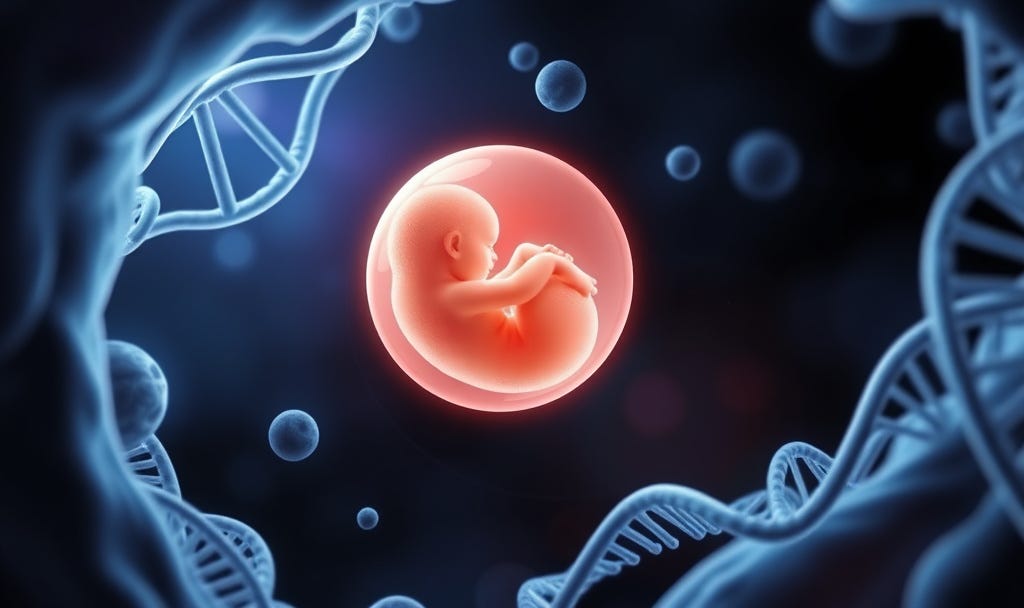
Hello. This week’s podcast begins by exploring the remarkable offering of PickYourBaby.com, from a company which claims it can help you select the precise genetic inheritance of your child through IVF, to ensure your offspring are taller, more beautiful, healthier and cleverer. There are plenty of questions around the supposed science of this, and its ethics. But beyond all that, why is this kind of service attractive to would-be parents in the 2020s? What does our culture think children are for, and what might a Christian narrative of parenthood and procreation say in response?
Listen below to the episode, or if you prefer scroll down to read the transcript.
Transcript
Tim Wyatt (00:01.666)
Well, hello and welcome to another episode of Matters of Life and Death. As always, I’m Tim Wyatt and I’m joined by my dad, John Wyatt. Hi, dad.
John (00:09.96)
Hi Tim.
Tim Wyatt (00:11.822)
And today actually you spotted the thing that set us off on a, on a rabbit warren. It’s adverts that have been appearing, I think it’s in New York City, you said in the US, with the slogan, pickyourbaby.com. What on earth are they selling at pickyourbaby.com.
John (00:29.138)
Yes, this is apparently an advert which has appeared on the New York subway and it’s being heavily promoted and so just out of interest, if you just type in pickyourbaby in all in one word dot com it takes you to a very glossy website. You better look at it.
Tim Wyatt (00:52.398)
I’m looking at it right now. It’s a carousel of some beautiful smiling looking babies. And it says in big text, have your best baby. Dear future parents, you dream about who your child will be. Their laugh, their health, their happiness. Now you can see your future child’s health traits and potential even before pregnancy begins because everyone deserves to be understood from the very beginning. It’s the modern way to plan a family guided by science and driven by love.
John (01:23.636)
What couldn’t possibly go wrong? Guided by science, driven by love.
Tim Wyatt (01:26.304)
Hmm. Driven by love. Sign me up. So what we’re talking about here is what’s sometimes called designer babies, isn’t it? It’s this idea that we can harness kind of cutting edge genetic testing to somehow ensure that our children that are born to us are the best version that they could possibly be.
John (01:51.368)
Yes, these predictions have been around for a long time. I remember somebody more than 10 years ago making a prediction that in the future, having babies by that old fashioned way of just trusting to genetic chance would be seen as completely irresponsible and old fashioned and that the modern way of having babies is by IVF, where you then create multiple embryos and basically select the embryo or embryos that you wish, most, obviously match your lifestyle.
Tim Wyatt (02:33.966)
So you can ensure that the child has over six foot in height and athletic build and predisposed to being a violin virtuoso as well as an academic Nobel Prize winning chemist and is athletic enough to be a quarterback and is also a sensitive soul and a poet and an artist and all these things.
John (03:00.084)
Actually, it does remind me because in the US and in number of other countries as well, there are sperm and egg donor banks where volunteers add, you know, send in their samples and then you can see these different possibilities and then you can have your own select which sperm and egg you’re going to use. And it’s interesting, they all have different commercial values. And I think you can predict, you know, that the most, particularly the eggs, the most valuable eggs come from women who are tall, blonde, have got a PhD and are musical and athletic. And if you’re small, dark and into chess, you know, you’re just never going to.
Tim Wyatt (03:46.584)
Funny that.
John (03:56.052)
It’s a of vision of the future though, where everyone is like a Barbie doll but with a PhD.
Tim Wyatt (04:03.212)
Yes. And there’s been lots of science fiction hasn’t there that’s kind of explore this idea that you know, in the future, we’ll get so used to kind of creating supermen and superwomen. The few kind of runts who are are homebrewed the traditional way with a roll of the genetic dice will be will be seen as a kind of underclass in all their kind of lispy short-sighted glory.
John (04:24.66)
Yes, Tim.
Tim Wyatt (04:26.01)
I mean, the thing is it’s laughable. And yet this is very much what pickyourbaby.com is leaning into. The basic idea is you send off a cheek swab. They sequence you and your partner’s DNA. And then they have a guess at when we smash this DNA together and you create a child. They send you back a little report. Its eye color will likely be this color. Its hair color will likely be this. Its height will be plus four inches above average. Its IQ will be plus 10 points above average. It has a minus 2% chance of autism. 2,014 other variables are allegedly on offer in this kind of preview you get before you’ve even actually made an embryo just by looking at your various DNA from from father and mother.
John (05:08.52)
Yeah, and obviously there’s a lot of this is sales hype. And, and yet there is a sort of hardcore of genuine science behind this, which goes to the fact that over the years, since it became possible to sequence an entire human genome, many research groups around the world, but particularly the UK has been leading the world in collecting large numbers of whole genome sequences and then comparing them with people’s outcome. And this is particularly now the focus in the UK is on collecting 100,000 genomes from newborn babies.
Tim Wyatt (06:00.394)
I mean, is it, do genes really work like that? I mean, I was led to believe that it was a lot more complicated than just have gene A get result B and that yes, fine. We could do this kind of pre-conception test and look at the mother and father’s genomes and we could even later on pick your baby will, will create up to, you know, I don’t know how many embryos. And then run sequence all their DNA and give you this breakdown, you know, that chance of breast cancer or type two diabetes or hair color and height and all this stuff. So you can select your preferred candidate to re-implant back into the mother’s womb. But is it, is this not just nonsense? I mean, the likelihood of you having an IQ cannot be accurately verifiably predicted from DNA alone. It’s just not true, is it?
John (06:52.134)
No, it isn’t true, just conceptually, different conditions range all the way, or different events in your life range all the way from 100 % genetic prediction to virtually zero genetic prediction. there are a large number of conditions where there’s virtually 100% link between the genome and the condition. If a certain genetic condition, sickle cell anemia, if you happen to be missing or have a particular variant at a spot in the genome, you will develop sickle cell anemia virtually 100%. At the other end will be something like your chances of having a car accident, you know, turns out to be well, not completely zero with your genome, but not very close.
Tim Wyatt (07:52.558)
Not very close. And most things saw somewhere in between the two poles.
John (08:18.984)
so most things fall somewhere in between. So that there is a genetic influence there is and that is often described as the heredity heritability. To what extent that particular thing is heritable, and to what extent it is due to the play of environmental factors. And again, there’s lots of debate and discussion about precisely how much is heritable. And IQ would be a good example where there’s a lot of debate. There is clearly an element of IQ. Of course, the next question is what is IQ? Well, IQ is the ability to pass IQ tests. It doesn’t necessarily mean something else, but nonetheless, if we just look at the ability to pass IQ tests, that is there is a percentage of heritability, but it is by no means 100%.
Tim Wyatt (08:31.81)
Hmm... No. And sure there are, you know, it’s well established, as we discussed in previous episodes about genetics, that there are certain genes that we know lead to a higher percentage chance of developing breast cancer, for instance. So certainly you could search for BRCA1 or these other genes that have been well identified as having a role. But various other swathes of other types of cancer, let alone something like autism, is clearly has a genetic component, but how exactly you can disentangle the various, maybe hundreds of different ways, thousands of ways that the different collection of genes can intersect with each other and then some environmental factors. I just feel like this pickyourbaby.com is writing checks that the science at this point can’t necessarily cash.
John (09:34.293)
Yes, and I think that’s a pretty accurate perception that there’s a great deal of hype and potentially misleading hype here. Again, having said that, there is a hardcore because what is happening is that literally millions of genomes are being sequenced around the world, prospective information is being collected. And this is where big AI
pattern recognition systems, if they spend their time, you know, come have a role and are being employed. And the idea being that you would come up with some kind of probability ranges for outcome based on this unique genome by comparing it to a million other genomes.
Tim Wyatt (10:30.478)
Yes. And we talked last time we discussed this about a year ago, wasn’t it when it was when that famous DNA genetic testing company 23andMe was on the brink of bankruptcy. I think it was actually in the end saved. But there was this big debate about what was going to happen to the 15 million genomes that had sequenced over the years and people sending in their saliva swabs in the post to find out, you know, that they’re 4% Canadian or whatever it was, who owns that DNA and actually increasingly it feels quite plausible that the 21st century will be marked by a kind of arms race in genetic databases. Because if you’re going to do that kind of mass AI based pattern recognition stuff, what we do know is that to feed AI, you need to feed it vast, vast troughs of data. And that’s one thing to find, you know, trillions of words written down to feed into a large language model. But if you’re trying to feed genomes into a genetic model, you need to have huge, huge databases and where are they going to come from? Is everyone going to have consented to give their DNA to teach and train this new kind of way of reading people and predicting what people’s genomes mean?
John (11:46.837)
Absolutely, and the other variable, if it comes to selecting an embryo, I mean, inevitably, the more embryos you create to choose from, the more options you have. And so if you only create five embryos, you’re going to be pretty limited. But if you create 100 embryos, and of course, there’s no fundamental reason why you can’t create an almost unlimited number of embryos if you can get the eggs. It’s all about eggs.
Tim Wyatt (12:19.054)
But it’s quite a gruelling process, understand, isn’t it? The kind of hyper ovulation and then harvesting, no, women say that going through that process just to produce and harvest the eggs is in itself quite physically and emotionally difficult.
John (12:34.0)
Absolutely it is. that’s why at the moment, again, there is all kinds of research going on. Would it be possible to create in the laboratory donor eggs rather than, you know, maybe from other cells, rather than having to harvest them directly from the human ovaries? So at the moment, that is the big limiting factor. It’s interesting that in this particular company, PickYourBaby.com, in their promotional material, they illustrate it with just five embryos, keeping it simple. But so I think from a scientific point of view, clearly there are deep concerns here. But I’d like particularly to try and think about the underlying social forces behind all this. Why is it that this, clearly there is a market here, there are people who are so desperate to be able to pick a baby that they would be prepared almost to go to any lengths. I wonder what you think are the underlying factors and forces.
Tim Wyatt (13:41.358)
Yeah. I mean, reflecting on this, it does feel like the kind of acme of our culture’s expressive individualism, you know, the kind of the kind of end point of several generations of individualism, replacing kind of communal feeling where people feel like they have a right or a duty even to themselves to kind of be the truest versions themselves that they can be. That the kind of the best thing, the most moral thing to do is to kind of live out your own unique purpose and calling and vision for your own life. And therefore having children becomes another avenue to express what is most significant and special about you and your partner. And that’s always obviously been an underlying element in procreation. You know, having children is the is the creating a new human from two kind of existing people, smashing their DNA together and seeing what pops out long before we understood what DNA was. But I think there is something particular about our current zeitgeist and its obsession with control and minimizing risk and refusal to kind of leave things to chance. I mean, the, branding and the kind of way that they, you know, this company is called Nucleus that runs PickYourBaby. It talks about it, you know, it’s all about the more you know, the more you can give your baby the best possible start, know, what knowledge is all power, you know, it’s, you know, imagine this, you’re going through IVF, doing everything you can. Cancer runs in your family. It’s always in the back of your mind. You’re shown five possible embryos, five possible paths forward. They all look the same. You’re left guessing. Then your doctor taps a button and the uncertainty lifts. You can see which embryo has the lowest risk for cancer. Finally, you have the clarity you didn’t have before. It’s very slick. It’s very well done, but it’s fundamentally preying on anxiety and a fear of a loss of control; that, my gosh, the worst possible thing would be to have a child that is predisposed to cancer, which runs in my family. I am prepared to spend any money, do anything to alleviate that anxiety that my child might not be the most perfect representation of me.
John (16:17.458)
Yes, it’s interesting, isn’t it? In some ways, it’s probably the fear, which is a bigger factor than the longing for a perfect child. It’s this idea that I am so terrified of having a child who could somehow suffer terribly, or else, to be honest, who could bring immense suffering into my life because looking after a child with special needs will add all kinds of suffering and therefore the most important function of the control is not to have a perfect baby, it’s to try to minimize these terrible risks, terrible fears.
Tim Wyatt (16:57.486)
What can go wrong? And we know, don’t we? I mean, I see it in my own generation, millennials, there is a higher levels of anxiety about things that could go wrong. People are, I think, a bit more risk averse. And I think that probably does feed into thinking around families and family planning. we know we’ve talked in previous episodes about how birth rates are dropping and there’s lots of complicated reasons why that’s happening. But I think one part of the cultural picture is that people are more nervous.
And the idea of having a child feels fraught and complicated and murky and tricky, let alone, you know, finding the right partner you want to raise that child with for the rest of their life. And yeah, I think a lot of, I can see this kind of advertising, this kind of message appealing to people who want to try and strip out some of the uncertainty and, kind of buttress the very scary thing of starting a family with a bit more control. Take away those possible horrible nightmare moments that we all fear that you go to the doctor’s office and they say we’ve got the test results back on your unborn child is going to be X, you know, which just wasn’t really a thing. I think for 30, 40 years ago, people just knew that there was there was huge jeopardy involved in children, you roll the dice and you saw what you got.
John (18:12.884)
I think that’s absolutely right. And it is one of the things that has really struck me is how all this is not just genetic testing, it’s everything to do with, know, ultrasound scans and all this prenatal screening is how it transforms what used to be a period of anticipation. You know, I don’t happen to clue what’s going on, you know, underneath my tummy, but something wonderful is happening and I’m really looking forward to meeting this new one. And now it’s, oh well, we’ve got to have some more tests and we’re just wondering what the risks might be. We’ve been told there’s a one in 170 chance of some terribly rare thing. If we had an MRI, would that help too? And it just transforms the whole thing into a deep sense of anxiety.
Tim Wyatt (19:13.24)
Hmm. And as we talked before, once you’ve kind of hinted or flirted or tempted people with the possibility of knowledge, even if you know that that knowledge is in itself crippling, because you can’t do anything about it, human beings just find it very hard not to choose not to know. It feels like the irresponsible thing to choose not to know, even though, imagine you could know for certainty that your child was going to be this height or that IQ or that eye color or this percentage chance of ASD. So you could do about any of those things. That’s all right done, isn’t it? Once the child is implanted and growing in your womb like that. people just feel irresponsible to turn away, to not harness the kind of power of modern science to know these things, even if that knowledge in itself doesn’t actually achieve anything for us.
John (19:48.282)
Absolutely. Yeah, I mean, another aspect of this is, you know, this is all eugenics, which is, again, it’s very interesting, the history of eugenics, because it was a remarkably common scientific idea in the earlier years of the 20th century. in fact, at UCL, there was a laboratory of eugenics, you know, the idea of using our knowledge to try to give people the best possible genetic inheritance. And then of course, the history of the Nazi Germany and the Third Reich, it meant that eugenics became completely taboo and utterly unimaginable. You know, we have decided that that approach of trying to understand and promote the best genetic inheritance is clearly wrong. And these are two terrible outcomes. But now, eugenics is being rehabilitated. And actually, you know, we’re going back to the idea that maybe that’s the responsible thing, trying to improve genetic inheritance.
Tim Wyatt (21:14.702)
But it’s been, but it’s been, it’s a radically different approach this time around with a very 21st century slant on it. Because my understanding of the kind of first wave of genetics is that it was all done on this kind of population level. The theory was like, you know, taking from kind of animal husbandry that we need to improve the breeding stock to sustain the health and vitality of the nation. You know, it kind of grew out of this kind of romantic nationalism and this idea that feeble minded people were having too many children, the poor were having too many children, the underclass were breeding and we needed to ensure that only kind of reputable healthy people and so that we could keep our national stock strong. So it’s incredibly collective and it was often even in Western countries, it was often done quite authoritarian-ly even in Western democracies, you know, they would be forcible sterilizations of people, if you’d be convicted of certain offenses to make sure that you couldn’t pass down your dangerous criminal heritability to another generation. It was all you know, the needs of the individual must suffer for the greater good of the collective nation. Whereas these days, under the guise of 21st century capitalism and expressive individualism, it’s a it’s completely around its eugenics, but done on an intensely individual level, solely. It’s liberal, because it’s all about choice of the parents, no one’s making you do it by the by the brute arm of the state. But rather than saying we want to improve the collective breeding stock of the nation, it’s all about you deserve the best child for your family, you deserve to eliminate the risks for your family, which is a very, very different kind of motivating ethos.
John (22:50.676)
It is, but of course we’re not all just individuals. These choices have social implications and certainly people who do have disabilities, just thinking about people with Down syndrome and families of children with Down syndrome is how they feel that this rhetoric, well, know, the fact that other people are screening out children with Down syndrome says absolutely nothing about how precious and valuable. We think your own child is or we think you are, but of course that’s just flannel. If Down syndrome is seen as something of such unique awfulness that death is better than survival, then that must say something wider about us as a society.
Tim Wyatt (23:19.34)
Yeah. And it’s very notable when there were debates in this country about introducing a new non invasive prenatal test or something like that, pre screening, yeah, which was a much more accurate way of identifying Down syndrome in the womb. It was often talked about quite positively by people as you know, we could eliminate Down syndrome. That’s what they’ve done in Iceland, you know, 99% of embryos identified as having Down syndrome are aborted. And I always felt well, we’re not we’re not eliminating Down syndrome. We’re not curing it. We’re just eliminating the people who have it and not allowing them to be born. But they continue, the genetic mutation that calls it continues to happen at exactly the same rate it always has. We’re just eliminating the people. And obviously, everyone with Down syndrome saw that very clearly themselves as well.
John (24:32.156)
Indeed. So, you know, there is this wider context in which so so it’s overly naive, willfully naive to say I’m just making individual choices. This says nothing about society as a whole. So I suppose just coming to specifically Christian perspectives on this, you know, what what what would we be saying to quite apart from the science?You know, how as Christians do we cut across this way of thinking?
Tim Wyatt (25:09.198)
I mean, we’ve talked before, haven’t we about the idea of receiving children as a gift from God, rather than seeking to kind of create them as an expression of yourself. I think there is a strong strain of thought in through the scriptures of children are a gift of God. You know, you see that in all those stories of of mothers who are unable to have children until kind of God’s miraculous interventions quite clearly framed as these children are a gift. And I think there’s wisdom, as we’ve talked about in many occasions about kind of going with the grain of the givenness of our of our bodies and our created, created natures, even including all its fallenness. We talked about that in context of things like transhumanism. And I guess this kind of designer baby genetic liberal eugenics is a form of pre prenatal transhumanism. In a way, we’re trying to use technology to improve humans beyond how they are by the creator’s design. So I think that would certainly give me pause from a Christian perspective.
John (26:16.492)
You could certainly say that, I suppose, in terms of selecting children who are purportedly going to have a higher IQ or outstanding athletic abilities or so on. But what about reducing the risk of cancer? mean, might that be more responsible?
Tim Wyatt (26:23.757)
Hmm. I think that’s how it will be perceived. That’s how it will be expressed and received into general culture in the same way that the what is now absolutely standard, you know, testing of children for various diseases, followed by recommendation for abortion if they test positive, is understood both by doctors and by most non-Christian parents as like the responsible caring thing to do. You’re told your child is a dud. You wipe the slate clean and you start again, right? Using deliberately provocative language there. And, I think that’s the way this would be understood. Why wouldn’t you pick you’re offered five embryos? Obviously the right thing to do is a pick the one that has the lowest chance of cancer. I guess I think it’s a bit of a mirage because you’re not really, if you could do this, genuinely do this pre conception, then I might be more open to it, but you can’t.
What we are actually doing is creating five embryos beings. as we’ve discussed many times the podcast. of complex ethical weight. that some Christians will understand as full and equal human beings and some won’t, but whatever they are, they’re not just clumps of cells. So we’re creating five potential lives, five new things, five potential image-bearers. And then we’re saying we’ll pick the best one and destroy or put on deep freeze. We’ll pick five embryos, we’ll pick the one that has the lowest chance of breast cancer and then the other four get discarded or destroyed. That will be presented as responsible, but that doesn’t actually, much like the Down syndrome thing, we’re not actually curing breast cancer. We’re not actually making its incidence lower. We’re not preventing breast cancer. We’re just choosing not to bring into full life four other potential human beings that might have had a slightly higher chance. It’s superficially appealing and seen as kind of moral and compassionate, but I think it’s a lot murkier than that.
John (28:35.848)
Yes, and I think quite apart from that, and I agree with that, quite apart from that, there is the fact that this child may or may not discover that this child has been specially selected for certain criteria. You know, what happens when suddenly the child develops some other medical condition that you weren’t unable to screen for, or a child doesn’t meet their parents’ expectations, some for other reasons, if you’ve selected, if you thought you were, you know, selecting a child for certain reasons, is this in some way changing your attitude to the child? And I think it must do. Your child is a product, a commodity, and now the commodity is not meeting the specification, you know, even if the child doesn’t know that they’re a commodity.
Tim Wyatt (29:31.256)
Yeah, absolutely right. And I think going back to the kind of Christian angle on this, I think what is quite clear, particularly from Jesus’s interactions with children is that in God’s eyes, are ends not means, that they are precious in and of themselves, not just what they bring to their families, which I think was probably quite a countercultural idea, both for the Jewish culture and also the kind of surrounding Greco-Roman one, which I think to our eyes, radically down downplayed children’s value and worth. You know, they might be valuable as kind of inheritors of the family estate, but Jesus saw them as people as valuable individuals, he wanted to spend time with them. And I think the risk is even again, it comes from a good place, parents who want to do their best by their children. But if you manipulate your children’s genetics, so that they most meet your own requirements, you are you are unavoidably commodifying your child. And that child becomes an expression of your desires, your will, rather than a brand new human being of equal value and purpose expanding your family. And I just don’t think that aligns with the kind of ethic of the child that you see in the New Testament at all.
John (30:41.652)
Yeah, and certainly I was very influenced by a book which came out 30 years or more ago, written by Oliver O’Donovan called Begotten or Made. He was pointing out, again, I think it’s something we’ve talked about in previous podcasts, but it’s nonetheless a very profound thought that, you know, in the Old English, begotten, which just means given birth to, that in the ancient Nicene Creed, which we’ve been celebrating the anniversary of, it says that Christ was begotten, not made, that he was given birth to, he was not created. And so the early church fathers were trying to differentiate between the creation which God had made and the origins of Christ. And what Oliver O’Donovan points out is that that the being that we make is a product of our will. It’s fundamentally different from us and we can define what it’s for and what its purpose is. Whereas the being that we give birth to, our children, are fundamentally equal to us. They’re not a product of our will. They’re a gift from our being, from our nature, and that we can’t define who they are, what they do, however much we wish we could. Children are going to go on and do their own thing. And parenthood is about stepping back and allowing your children to become the persons they were meant to be. You help them along in the process, but ultimately they... And it’s a very profound thought, think. And what O’Donovan was saying is that reproductive technology is tending to push us to think of our children as being made as opposed to, and therefore we can control them.
Tim Wyatt (32:46.082)
Yeah. No, I think that’s, that puts his finger on it. Absolutely right. This is all part of a piece of, yeah, encouraging deluding, you could say parents to believe that they can make their own children in a kind of Lego kit way. We’ll bolt on, maybe we’ll choose one with this gene here. Cause it’s a short step, right? From create multiple embryos and pick the one that has the best cocktail of genes to, well, why would we leave the cocktail of genes at the chance? Why don’t we start using CRISPR and other DNA editing technology when they’re at this early stage and start just literally choosing rather than producing endless hundreds of genome of embryos by chance to see which one is the best. Why don’t we just start choosing our own and you can say, I want this gene for that and this gene for that. And you literally have designed your own designer baby. And that is just so at odds with how, which, as you say, that idea of children being of one with us of equal value and status begotten, but not created.
John (33:42.963)
Yeah, and of course a similar kind of thing happens after birth. I want my precious little darling to become a concert pianist, so I am now going to enroll them from the age of three in this 10,000 hour programme and force them to do the necessary, to get the virtuoso that I want. And it’s a bit of a caricature, but it’s only a bit of a caricature, isn’t it?
Tim Wyatt (34:07.982)
Well, I’m sure you used to teach medical students. How many times did you come across one who was self-evidently only there because mother and father were desperate to have a doctor son or daughter?
John (34:17.79)
Well, yeah, wasn’t that unusual. And actually, they were by and large very disaffected. They weren’t genuinely interested. They got there because they’d been pressed into it. I think a lot of people, even if they go to eventually get qualified, they often leave medicine within the first few years, because frankly, it’s too much like hard work. It’s not what I really want to do with my life. I think it’s a controlling spirit of the age which still sees the child as a product of my will.
Tim Wyatt (34:59.086)
Yeah. And I suppose we have to be careful here. I’m just aware that the kind of ethic of parenting that we’re sketching out is very much in vogue with a kind of 20th century approach, whereas, you know, lots of Christians would look at the scriptures and say, what, you know, it’s in the 10 Commandments, honor thy father and mother. You know, there’s lots of the household codes in some of the Pauline epistles, quite clearly set up these kind of hierarchies of authority within households and children under the authority of their parents. So we shouldn’t push it too hard in the sense that don’t think it’s contrary to Christian doctrine and teaching that parents do have a high degree of authority over their children and children do owe their parents a kind of loyalty and respect and honor and even obedience that that isn’t owed between two adults per se.
John (35:48.277)
Absolutely right, but I would say that is something quite separate from this kind of controlling. So yes, of course we have a responsibility to nurture and help form our children. But you know, the traditional meaning of education is e ducare, which apparently means to lead from, it is to draw out from the child their own capabilities and interests. It’s not about impressing, controlling, forcing. And that’s what I see the task of education and the task of parental education. You are guiding, forming your child. You’re not imposing your own perspective, but nonetheless, you’re creating a framework of Yeah, this is discipline, these are the rules, this is... But the ultimate goal is for the child to be formed, to become their own, the unique person that God made them to be.
Tim Wyatt (36:56.27)
Hmm. And you can see how that completely is in the line with if you receive children as a gift, because you say all the latent potential inside them, all of the gifts and abilities and aspirations and personalities. That is only that is nothing that’s not of my own choosing as the parent, I had no control over that in the the only person who saw as we talked about before, you know, in the mystery and the darkness of the womb, when the one particular sperm that was going to get to the egg first and create this unique fusion of two people’s genomes was God. And therefore God is ultimately the creator of this individual, not me. And therefore I, my job is to draw out what I see God has already placed in my child in the most kind of godly way possible. Whereas if you place those things in your child, because you started messing around with a genome, whether through selective IVF or through some more kind of sci-fi gene editing, what you’re drawing out with stuff that you’ve already decided. As you say, I’ve already decided this person’s going to be an athletic virtuoso concert pianist and a PhD chemist. So I’ve got to draw out those things, even if that’s actually not what my child is being placed in their heart to be.
John (38:11.988)
Yeah, it’s interesting, isn’t it? So at heart, I think the Christian view says, actually, I’m called to respect my child. I’m called to respect their God-givenness. I’m called to respect their individuality. That doesn’t mean I don’t have a responsibility to discipline them and form them. But nonetheless, whereas this instrumental view seems to me the opposite of respect. It is this thing, my child, I am going to mould them. I’m going to make them subject to my desires, my will. And fundamentally that just seems antithetical to this sense of helping an individual to flourish.
Tim Wyatt (38:55.15)
I mean, what’s that famous verse that every child has quoted back at their parents in Ephesians, fathers do not exasperate your children. know, there is, there is a, you know, instead bring them up in the training and instruction of the Lord. So like, clearly there is a huge role, God-given role to, to shape and form your children and to put in boundaries, healthy boundaries, including, as you say, that will include at times discipline, but it’s fundamentally don’t exasperate them, don’t impose upon them unhealthily.
John (39:04.294)
Indeed.
Tim Wyatt (39:25.166)
Take take your lead from God rather than from trying to see this as a mini-me and I’m trying to project everything I think is valuable and important and replicate it in this tiny human being that I have this awesome responsibility to shape their plastic brain and body as it develops.
John (39:42.388)
Well sounds great Tim, but you know, as a father, how are you doing so far?
Tim Wyatt (39:43.919)
Easier said than done. Yeah, not great. Not great. Yeah, it’s a good challenge to me because I do have a struggle with that aspect of parenthood where you realize that the child is not going to do exactly what you want them to do, both in places where they should obey you. And that’s just exasperating. But also when, you know, you have to begrudgingly admit that it is entirely their choice, whether or not they’re into X, Y, and Z, or, or they value ABC in the way that you do. And it is you do have to constantly kind of humble yourself and lay that down and say, try and think yourselves back into being a young person again. And what would it be like if my dad had been trying to, to squeeze me into a predefined box of what they thought, what he thought was good. So it is a helpful, a helpful rebuke and corrective to myself as I say.
John (40:31.592)
Yeah, well, we always get it wrong, Tim, but you know, that’s somehow by God’s grace. Forgiveness, forgive your parents. Very important.
Tim Wyatt (40:34.158)
Yeah, there’s grace. There’s grace for that. Forgive your parents. They were doing their best. They were doing their best.
John (40:43.986)
Okay, maybe we should call it a day.
Tim Wyatt (40:45.74)
Let’s call it a day. Yeah, let us know what you thought. Would you ever been sitting in choosing the genes of your children? Do you feel like your parents exasperated you? Maybe that’s not… we can’t really help with that one. You know, take them up with that directly. But take it up with them or with the Almighty. But no, we’d love to hear your thoughts, your challenges, your disagreements, or anything else that you’ve spotted, whether on the New York subway or elsewhere that has provoked thought for you do send it in to MOLAD@premier.org.uk. We love to hear questions and comments from listeners that helps shape this podcast and sharpen our own thinking. So thank you for those who have been getting in touch. There’s lots of more material on this on dad’s website. That’s johnwyatt.com. And in particular, I’ll push you back to an episode we did about a year ago called DNA, parenthood and selecting for IQ: the surprising return of eugenics which covered some similar ground when we were looking at some a few other US firms doing kind of selecting for intelligence other things allegedly in their embryos and what Christians might think about that. And you can find some of my own journalism if that interests you at my website, which is tswyatt.com. Thanks for listening, everyone. We’ll be back next week with another episode. But until then, bye bye.